Sales: 1 (844) 923-3937
Service & Parts: 1 (819) 322-3937
Please note that we will be closed on June 24 for Saint-Jean-Baptiste Day

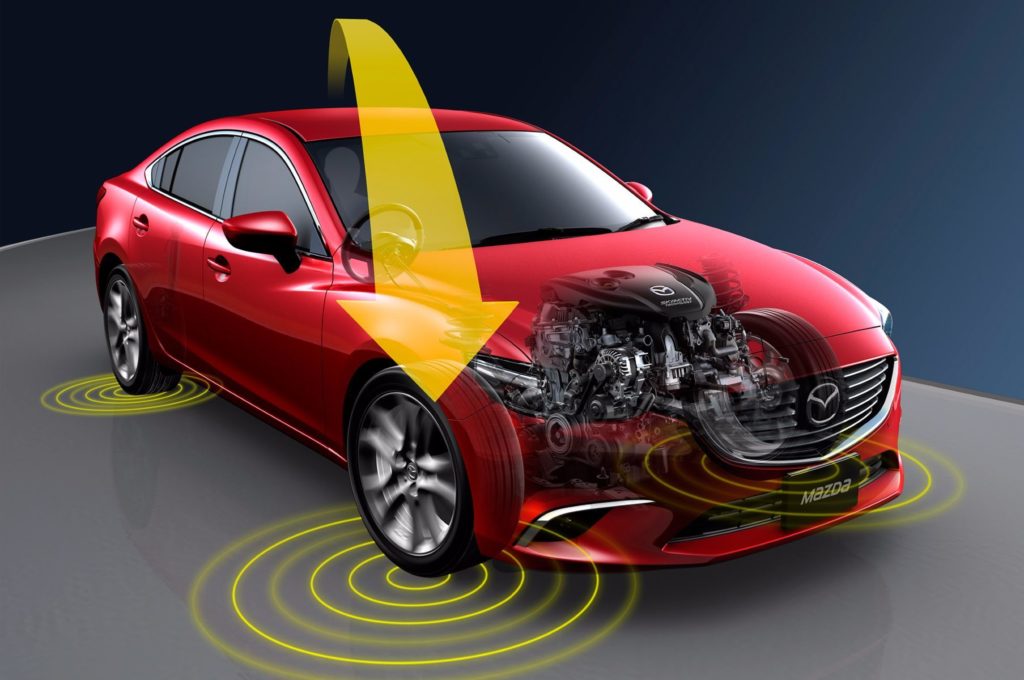
Mazda aims to offer its customers vehicles that provide driving pleasure and enrich their lives. We achieved this goal by continuing the Jinba Ittai concept, concept that the driver and the vehicle are one. Vector control force g is the first technology in the SKYACTIV-VEHICLE DYNAMICS series and is part of the series of SKYACTIV technologies. The SKYACTIV-VEHICLE DYNAMICS technologies have been developed to provide an integrated control of the engine, gearbox, chassis and bodywork to increase the Jinba Ittai feeling of the vehicle: a connection feeling between the car and the driver distinguishes the Mazda vehicles of other vehicles.
Increase the performance of the chassis using the SKYACTIV engine.
Vector control g force is made possible only through the existence of SKYACTIV engines, which provide precise control of the engine torque, and with the SKYACTIV-CHASSIS chassis, which provides the vehicle holding a perfect road. The G-vector control (GVC) optimizes tire performance by concentrating the vertical load on the tires. When the driver changes direction, the vector-control G (GVC) varies the torque to create a deceleration g force and transferring the load to the front wheels. This has the effect of increasing adhesion of the front wheels to the road surface, thus improving the response of the vehicle when cornering.
Thereafter, when the driver maintains a constant steering angle, the G-vector control (GVC) immediately restores the engine torque, which transfers the load to the rear wheels, improving stability.
This series of charge transfer provides a much better grip front and rear wheels to the pavement, which aligns response and stability of the vehicle to the driver’s intentions.
A natural feeling of control based on a human-centered development philosophy.
Mazda’s engineers studied the biomechanical relationship between man and moving vehicles to refine the vector control system of g-force to promote optimal harmonious interaction. They lined the rate of reaction and control niveua on human sensibilities.
The stresses at the wheel allow the driver to keep the vehicle in its lane, either straight or in curves. However, due to erratic and undulating road pavement, the vehicle is not always in his way as expected, forcing the driver to make adjustments to management.
Since the G-vector control (GVC) provides improved response to the slightest stress of driving, it has the effect of greatly reducing the size and frequency of adjustments to management.
The G-vector control (GVC) is as effective in reducing fatigue in the driver and passengers. Fatigue felt by the driver intensifies as and when it needs to make minor corrections to management. Since the G-vector control (GVC) helps reduce the number of corrections, it reduces fatigue during long trips. Moreover, by making transfers more fluid force g, the vector-control G (GVC) suppresses the swaying of the head and torso suffered by vehicle occupants, allowing them to enjoy a more comfortable ride.

We are in spring! This is also the time to do some checking and some changes to prepare his car for summer conditions. Here are 5 things to do on your vehicle just before the arrival of warm weather.
There is not a long time ago, to save money, many drivers were driving all year the 4-season tires. These tires are dangerous in winter, for which the government now requires that every car equipped with winter tires in winter. Warning! Winter tires are not new Four Seasons! From 8 degrees Celsius, approximately, they lose their grip. Not only they are not safe in hot weather, they also damage more quickly. Having two sets of tires is a safe measure, and in the end, more economical.
Ideally, the oil is changed from one vehicle to every 5000 km, 10 000 km if the engine runs on synthetic oil.
However, if you use very little car, it is possible that 5000 km is for you a year of use. It is still recommended to change the oil after the winter, just to maximize your car’s fuel economy for the summer.
A bit like tires, washer fluid is not designed to be used in summer and winter. For example, many mixes are optimized to clean squashed insects on the windshield and keep rain, while others are optimized for cold weather and to clean calcium.
Use summer windshield washer during winter can cause serious accidents, since it will freeze on the windshield, depriving you of visibility. The winter washer fluid is not as dangerous if used off-season, but it works less well in hot weather. To replace, gradually add the summer washer in your tank from April. Unless otherwise indicated, it is possible to mix the two.
Winter exacts a heavy toll on our roads. The holed, the cracks and irregularities in the pavement will quickly made misalign the wheels of your car. A poorly inlined car tires wear out faster, will waste gasoline and will be harder to keep straight.
It is therefore recommended to check the wheel alignment at time of summer tires on the car. Most garages now have high precision machines that ensure an optimal driving experience. However, be aware that to bring a car can be expensive. There is talk of a base price around $ 80. But again, you will save $ 80 this increases the service life of your tires.
The dirt that accumulates throughout the winter on your car damages the clear coat paint your car, in addition to increasing the risk of rust.
It is recommended to do a deep cleaning of your car in the spring to minimize the risk of corrosion. If you can, do apply a wax or paint sealant on the car in order to protect against UV rays of the summer sun.
If you have not already done it, consider taking now an appointment by phone at 819-322-3937 or on our website.


